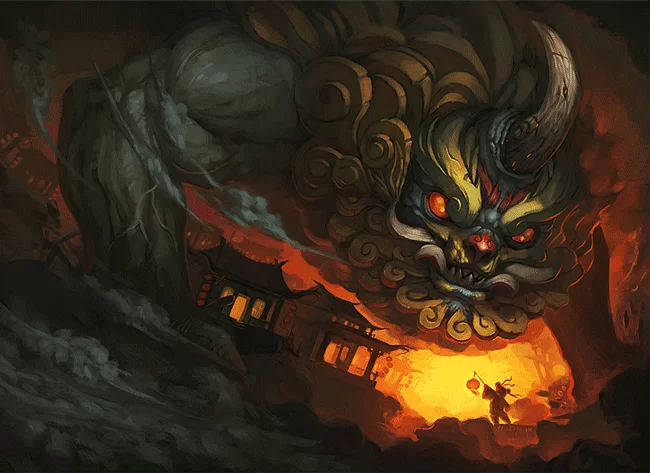
There are many stories and legends surrounding the history of Chinese New Year worth mentioning. The first and most well known is the legend of Nian (Year “Nian” as in New Year –”Xin Nian”). There are two versions of the legend of Nian, both include a scary beast with characteristics of a lion, ox, and unicorn, that had a dragon like appearance.
What is the Legend of Nian?
As the story goes, there was a monster in ancient times with a body of a bull, head of lion, and horn of a unicorn. It was a ferocious animal that lived in the mountains and hunted for a living. Towards the end of winter when there was nothing to eat Nian would visit the villages and attack and eat whatever it could causing the villagers to live in terror.
One night, at the end of winter, when Nian was spotted coming down the mountain some villagers started fires, put up boards painted with scarlet, and stayed up all night long making various load noises. The monster came down saw and heard the ruckus, freaked out, and ran into the mountains never to return again. The next morning everyone congratulated each other and had a big celebration. The following year, all the villagers came together and agreed that when it was time for Nian’s annual visit towards the end of winter they would start a fire in front of every door, hang a scarlet painted board in front of every house, and not go to sleep but rather make noise by the furious beating of drums, gongs, and cymbals, along with the heavy use of firecrackers.
In the second version of the legend of Nian the monster lived at the bottom of the sea most of the year and would only go ashore on the last day of the Chinese lunar calendar to attack and eat both villagers and livestock. In this version the villagers made a large replica of the monster out of bamboo, colorful paper, and cloth (scarlet red & orange). They used this replica along with furious beating of drums, gongs, cymbals, and the heavy use of firecrackers to scare away Nian.
Over time all the villagers realized that the ferocious monster Nian was afraid of three things: the color scarlet, fire, and noise. The next year they repeated the ritual and it has been passed down generation to generation until today, and thus the custom of Guo Nian (过年) was established based on the legends of Nian.
Chinese New Year History
The Chinese New Year (農曆新年, Nónglì Xīnnían), also known as the Lunar New Year is the most important of the traditional Chinese holidays. It is celebrated on the first day of the first month of the Chinese Lunar Calendar (the first day of the second new moon after the day on which the winter solstice occurs, unless there is an intercalary eleventh or twelfth month in the lead-up to the New Year—in such a case, the New Year falls on the day of the third new moon after the solstice). The Chinese New Year holiday also known as Spring Festival starts on the first new moon of the lunar calendar and ends with the Lantern Festival which occurs on the fifteenth day of the first month of the Lunar New Year (which is a full moon).
The old Chinese word “Nian” translates to “ripe grains.” This word dates back more than three thousand years to oracle bone inscriptions inscribed with astronomical records during the 14th Century B.C. Shang Dynasty. Before the Gregorian Calendar, a good harvest or the process of a harvest was considered a year. The sole purpose, in early history, of creating a calendar or keeping track of time was to facilitate agriculture. It was important to know when to till the soil and sow the seeds.
The first calendar in China had strong roots based on the benefit of agriculture production. During the Zhou Dynasty the year was formally called “Nian” and the beginning of the year was called “SuiShou”. In 104 BC, Emperor Liu Che of the Western Han Dynasty presided over the formulation of the solar lunar calendar which is similar to the Hebrew Calendar.
Since the beginnings of the Han Dynasty, New Years Day as well as the Winter Solstice were the Emperor’s most important dates. In ancient China it was the responsibility of the Emperor to keep track of important dates, perform traditional rituals, and select the music so that heaven and earth were in harmony. The marking of the Winter Solstice was an important event because if an emperor miscalculated, the kingdom wouldn’t know which day marked the coming of the New Year. Thus, these two historical dates of the Lunar Calendar are traditionally set in stone.
Historically, the Spring Festival was a way of letting the people know what time it was to do what. The Lunar Calendar has all sorts of important days to keep people in tune with their daily rituals and Chinese Culture. Keep in mind that the emperors of old did not do everything by themselves and had experts or “officials” to help out, but the burden of responsibility was always on the ruling emperor. By insuring the accuracy of these important dates, the state and the people knew when to work and when to do what. The Chinese Lunar Calendar is similar to the Western Farmer’s Almanac.