For the sake of cross cultural birding we also included the birds’ name in mainland China in Chinese, Pinyin and its literal translation. Be sure to download the PDF guide if you plan to go birding in Qingdao — It includes photographs of each bird. Happy Birding!
The guide bellow is in taxonomical order. Field marks and status (Qingdao resident, here for the winter, for the summer or a migrant bird) are also included.
Online Guide for Birds of Qingdao:
Common Pheasant (Phasianus colchicus) – Resident
Field marks: large, pointed tail, brown, red and green head, white neck ring.
环颈雉 – huán-jǐng zhì- ‘ring-necked pheasant’
雉鸡 – zhì-jī – ‘pheasant fowl’ (M&P, Atlas, Alternative in Cheng)
Great Spotted Woodpecker (Dendrocopos major) – Resident
Field marks: large black and white, white cheek, red head spot.
大斑啄木鸟 – dà bān zhuó-mù-niǎo – ‘large striped/spotted wood-pecking bird’
斑啄木鸟 – bān zhuó-mù-niǎo – ‘striped wood-pecking bird’ (Viney)
Note: Also named Picoides major.
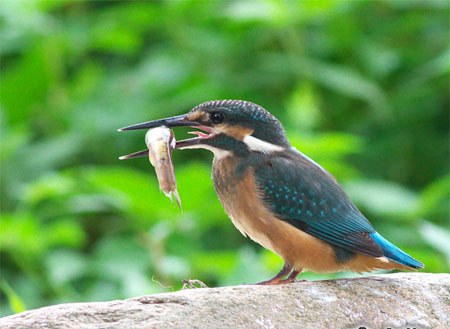
Common Kingfisher (Alcedo atthis) – Resident
Field marks: Green, wings and head, orange belly, blue back, long bill.
普通翠鸟 – pǔtōng cuì-niǎo – ‘common cui bird’
Spotted Dove (Streptopelia Chinensis) – Resident
Field marks: pinkish brown long tail, black spotted patch on side of neck, white on the tip of the tail.
珠颈斑鸠 – zhū-jǐng bān-jiū – ‘bead-necked striped dove’
Common Hoopoe (Upupa epops) – Summer
Field marks: Long bill, large frilled crest, browning black and white striped wings and tail.
戴胜 – dài-shèng – ‘wear headdress’
Forked-tailed Swift (Apus pacificus) – Resident/Summer
Field marks: Long slender wings, forked tail, white rump patch.
白腰雨燕 – bái-yāo yǔ-yàn – ‘white-rumped rain-swallow’
Eurasian hobby (Falco Subbuteo) – Summer
Field marks: falcon shaped, long tail, long pointed wings).
燕隼 – yàn-sǔn – ‘swallow falcon’
Eurasian Eagle Owl (Bubo bubo) – Resident
Field marks: Rare, huge, long ears, orange eyes
鵰鸮 – diāo-xiāo – ‘eagle owl’
Oriental Scops Owl (Otus sunia) – Summer
Field marks: small, mottled brown, short ears, yellow eyes.
红角鸮 – hóng jiǎo-xiāo – ‘red horned owl’
东方角鸮 – dōngfāng jiǎo-xiāo – ‘Oriental horned owl’ (M&P)
Tawny Owl (Strix aluco) – Resident
Field marks: medium sized, brown, no “ears”, mottled brown.
灰林鸮 – huī lín-xiāo – ‘grey forest owl’
Black-headed Gull (Larus ridibundus) – Migrant
Field marks: white and gray, black head, red head.
红嘴鸥- hóng-zuǐ ōu – ‘red-billed gull’
Common Tern (Sterna hirundo) – Summer
Field marks: white and grey, black head cap, long bill.
普通燕鸥 – pǔtōng yàn-ōu – ‘common swallow-gull’
Little Tern (Sterna albifrons) – Summer
Filed marks: small, white and gray, black cap with white near bill.
白额燕鸥 – bái-é yàn-ōu – ‘white forehead swallow-gull’
Black-eared Kite (Milvus lineatus) – Resident
Field marks: dark brown hawk with slightly forked tail, white patches near wing tips (in flight).
黑耳鸢 – hēi-ěr-yuān -‘black-eared kite’
麻鹰 – má-yīng – ‘flax eagle’
Note: Milvus lineatus is a subspecies of Milvus migrans.
Common Kestrel (Falco columbarius) – Resident
Field marks: long grey tail, black pointed wings, streaked belly.
红隼 – hóng sǔn – ‘red falcon’
Great Crested Grebe (Podiceps cristatus) – Migrant
Field marks: large, crested, long neck.
凤头䴙䴘 – fèng-tóu pìtī – ‘phoenix-headed grebe’
Grey Heron (Ardea cinerea) – Resident
Field marks: large, long bill and legs, grayish.
苍鹭 – cāng-lù – ‘dark blue heron’
Great Egret Egretta Alba – Resident
Field Marks: large, long bill and legs, all white.
大白鹭 – dà bái-lù – ‘large white heron’
Note: The Great Egret is also called Great White Heron. It also has two other Latin names Ardea alba and Casmerodius albus.
Little Egret (Egretta garzetta) – Resident
Field marks: long legs, long bill, small all white.
白鹭 – bái-lù – ‘white heron’
Note: Can be seen at Liu Tin River out near the airport;
a dozen or more noticed more than once.
Barn Swallow (Hirunda Rustica) – Summer
Field marks: forked tail, blue above, white below, rusty throat.
家燕 – jiā-yàn – ‘house swallow’
Brown Shrike (Lanius cristatus) – Summer
Field marks: grayish above, light brown below, black eye “mask”.
红尾伯劳 – hóng-wěi bóláo – ‘red-tailed shrike’
褐伯劳 – hè bóláo – ‘brown shrike’ (Alternative in Cheng)
Tiger Shrike (Lanius tigrinis) – Summer
Field marks: black mask, white below, dark brown above, grey head cap.
虎纹伯劳 – hǔ wén bóláo – ‘tiger-pattern shrike’
Black-billed Magpie (Pica pica) – Resident
Field marks: common iridescent black and white long tail. Black part of bird appears to be a green to a blue in the right angle of light.
喜鹊 – xǐ-què – ‘magpie’
Azure winged Magpie (Cyanopica cyanus) – Resident
Field marks: black head, blue wings, loud blue tail, and white below.
灰喜鹊 – huī xǐ-què – ‘grey magpie’
Blue Magpie (Urocissa erythrorhyncha) – Resident
Field marks: red bill, white capped black head, blue above.
红嘴蓝鹊 – hóng-zuǐ lán-què – ‘red-billed blue magpie’
Note: Also called Red-billed Blue Magpie.
Red-billed Chough (Pyrrhocorax) – Resident
Field marks: All black except for red feet and curved bill.
红嘴山鸦 – hóng-zuǐ shān-yā – ‘red-billed mountain crow’
Large-billed Crow (Corvus macrecynchos) – Resident
Field marks: All black, heavy bill.
大嘴乌鸦 – dà zuǐ wū-yā – ‘large-billed crow’
Black-naped Oriole (Oriolus chinensis) – Summer
Field marks: all yellow except for wing tips and tail, black mask, long pinkish bill.
黑枕黄鹂 – hēi-zhěn huáng-lí – ‘black naped yellow oriole’
Ashy Drongo (Dicrurus leucophaeus) – Summer
Field marks: all grey, deeply forked tail, red eye.
灰卷尾 – huī juǎn-wěi – ‘grey curl-tai
Light-vented Bulbul (Pycnonotus Sinensis) – Summer
Field marks: Olive colored, white throat, cheek crest spot.
白头翁 bái-tóu wēng or ‘white-headed old man’
Note: Has been spotted in the winter and may possibly be resident.
Asian Paradise Flycatcher (Terpsiphone paradisi) – Summer
Field marks: Extremely long tail, white or brown body, blue crested head.
寿带 – shòu-dài – ‘longevity ribbon’
寿带鸟 – shòu-dài-niǎo – ‘longevity ribbon bird’ (Alternative in Cheng, Viney, Atlas)
Siberian Blue Robin (Luscinia Cyane) – Migrant
Field marks: small, blue above, white below, black cheek.
蓝歌鸲 – lán gē-qú – ‘blue song robin’
Blue Whistling Thrush (Myophonus caeruleus) – Summer
Field marks: All bluish black.
紫啸鸫 – zǐ xiào-dōng – ‘purple whistling thrush’
Daurian Redstart (Phoenicurus Auroreus) – Summer
Field marks: white wing patch, rusty breast and belly, black wings and throat.
北红尾鸲 – běi hóng-wěi-qú – ‘northern red-tailed robin’
Note: Though seen in Chen yang as late as December, possible resident.
Plumbeous Water Redstart (Rhyacornis fuliginosus) – Resident
Field marks: small, tiny bill, grayish-blue with rusty tail, always near water.
红尾水鸲 – hóng-wěi shuǐ-qú – ‘red-tailed water robin’
Note: Can also be called Plumbeous Redstart.
Eurasian Nuthatch (Sitta europaea) – Resident
Field marks: tiny, black eye stripe, grey and light brown, descends trees head first.
普通䴓 – pǔtōng shī – ‘common nuthatch’
Great Tit (Parus Major) – Resident
Field marks: head and throat black, white cheek, black band through breast.
大山雀 – dà shān-què – ‘large mountain finch’
Dusky Warbler (Pylloscopus fuscatus) – Migrant
Field marks: small, drab brown, white throat, white stripe over eye.
褐柳莺 – hè liǔ-yīng – ‘brown willow warbler’
Vinous-throated Parrotbill (Paradoxornis webbianus) – Resident
Field marks: pinkish brown, small bill, light streaks on belly.
棕头鸦雀 – zōng-tóu yā-què – ‘reddish-brown headed crow finch’
棕翅缘鸦雀 – zōng-chì-yuán yā-què – ‘reddish-brown wing-edge crow finch’ (Cheng)
Oriental Reed Warbler (Acrocephalus sophiae) – Summer
Field marks: large song birds, brownish above, white below, whitish stripe over eye, throat streaks.
方大苇莺 – dōngfāng dà wěi-yīng – ‘Oriental large reed warbler’
大苇莺 – dà wěi-yīng – ‘large reed warbler’ (Viney)
Pallas’s Leaf Warbler (Pyllscopus proregulas) – Migrant
Field marks: small, green back, yellow rump, two wing bars, stripe over eye, white below.
黄腰柳莺 – huáng-yāo liǔ-yīng – ‘yellow-rumped willow warbler’
Yellow-browed Warbler (Pylloscopus inoratus) – Migrant
Field marks: small, green back, two wing bars, stripe over eye, white below.
黄眉柳莺 – huáng-méi liǔ-yīng – ‘yellow-browed willow warbler’
Arctic Warbler (Pylloscopus borealis) – Migrant
Field marks: larger than other warblers, long yellow stripe over eye, bill slightly upturned.
极北柳莺 – jí běi liǔ-yīng – ‘extreme north willow warbler’
Two-barred Warbler (Pylloscopus plumbeitarsus) – Migrant
Field marks: two sharp wing bars, prominent stripe over eye, uniformly green above.
双斑绿柳莺 – shuāng-bān lǜ liǔ-yīng – ‘double-barred green willow warbler’
暗绿柳莺 – àn-lǜ liǔ-yīng – ‘dark-green willow warbler’ (Viney – Clashes with P. trochiloides)
Notes: Also called Two-barred Greenish Warbler.
Radde’s Warbler (Pylloscopus schwarzi) – Migrant
Field marks: uniformly brownish olive, no marking except for light stripe above eye.
巨嘴柳莺 – jù-zuǐ liǔ-yīng – ‘giant-billed willow warbler’
White Wagtail (Motacilla Alba) – Summer
Field marks: wags tail, patchy white and black.
白鹡鸰 – bái jílíng – ‘white wagtail’ – Note: Also called Pied Wagtail (Chen)
Eurasian Skylark (Alanda arvensis) – Winter
Field marks: mottled grayish brown with streaks, has erectile crest.
云雀 – yún-què – ‘cloud sparrow/finch’
Note: Also called Northern Skylark.
Oriental Grey-capped Greenfinch (carduelis sinica) – Resident
Field marks: grey, thick pink bill, yellow patch on wing.
金翅雀 – jīn-chì-què -‘gold wing finch’
金翅 – jīn-chì – ‘gold-wing’ (Alternative name given in Cheng, M&P, Atlas)
Note: Also called Chinese Greenfinch.
Yellow-billed Grosbeak (Eophona migratoria) – Migrant
Field marks: large, very thick bill, black wings and head, yellowish green.
黑尾蜡嘴雀 – hēi-wěi là-zuǐ-què – ‘black-tailed wax-billed finch’
Note: Also called Black-tailed hawfinch (Cheng) and Chinese Grossbeak.
Japanese Grosbeak (Eophona personata) – Migrant
Field marks: large, very thick bill, black wings and head, yellowish green, like Yellow-billed Grosbeak but bill is all yellow and bigger.
黑头蜡嘴雀 – hēi-tóu là-zuǐ-què – ‘black-headed wax-billed finch
Note: Also called Masked Hawfinched.
Little Bunting (Emberiza pusilla) – Migrant
Field marks: small, brown, striped head, eye ring.
小鹀 – xiǎo wú – ‘small bunting’
Yellow-throated Bunting (Emberiza Elegans) – Migrant
Field marks: black and yellow head pattern crest.
黄喉鹀 – huáng-hóu wú – ‘yellow-throated bunting’
Note: Also called Yellow-headed Bunting.
Chestnut-eared Bunting (Emberiza fucata) – Migrant
Field marks: fairly large, dark brown ear patch, grey head crown, white throat bordered by black streaks.
栗耳鹀 – lì-ěr wú – ‘chestnut-eared bunting’
赤胸鹀 – chì-xiōng wú – ‘red-breasted bunting’
Note: Also called Grey-headed Bunting or the Grey-hooded Bunting.
Yellow-breasted Bunting (Emberiza aureola) – Migrant
Field marks: brown above, yellow below, white bar on upper wing.
黄胸鹀 – huáng-xiōng wú – ‘yellow-breasted bunting’
Chestnut Bunting (Emberiza rutila) – Migrant
Field marks: head, back and throat brown, belly yellow.
栗鹀 – lì wú – ‘chestnut bunting’
Eurasian Tree Sparrow (Passer Montanus) – Resident
Field marks: common brown and white, black throat cheek spot, reddish brownish crown.
麻雀 – má-què – ‘sparrow’
树麻雀 – shù má-què – ‘tree sparrow’ (Alternative in Cheng, M&P, Atlas)
Hello, I will be visiting Qingdao the first week of November (in 2 weeks). Is it possible to hire a birding tour or a birding guide? I am interested in bird photography. Thanks in advance for your answer.