Search
Enter Keywords:
Official Website arrow News, Reviews arrow Current Events arrow Dragon Boat Festival :: May 28th - 30th, 2009
Dragon Boat Festival :: May 28th - 30th, 2009 Print
Dragon Boat FestivalHistory and Culture of Dragon Boat Racing
Modern Chinese scholars and anthropologists believe the use of dragon boats for racing and dragons as mythical creatures originated in southern China more than 2,500 years ago.  During the same era when the games of ancient Greece were being established at Olympia, Dragon boat racing as the basis for annual water rituals and festival celebrations, and for the traditional veneration of the Asian dragon water deity began along the banks of such iconic rivers as the Yangtze (Chang Jiang).

The Heavenly or Celestial Dragon
The Chinese Dragon as a mythical creature plays the most recognized role within ancient Chinese mythological traditions.  For instance, of the 12 animals of the Chinese Zodiac the only mythical creature is the dragon; the rest are not mythical (dog, rat, tiger, horse, snake, rabbit, rooster, monkey, sheep, ox, pig - all of which are familiar to agrarian peasants).

Dragons are traditionally believed to be the rulers of rivers and seas and dominate the clouds and the rains of heaven.  There are earth dragons, mountain dragons and sky or celestial dragons (Tian Long) in Chinese tradition.

According to legand, sacrifices (sometimes human) were involved in the earliest boat racing rituals.  During these ancient times violent clashes between the crew members of the competing boats involved throwing stones and striking each other with bamboo stalks.  Originally, paddlers or even an entire team falling into the water could receive no assistance from the onlookers as their misfortune was considered to be the will of the Dragon Deity which could not be interfered with.  Those boaters who drowned were thought to have been sacrificed. That Qu Yuan sacrificed himself in protest through drowning speaks to this early notion.

Dragon boat racing traditionally coincides with the 5th day of the 5th Chinese lunar month (varying from late May to early June on the modern Gregorian Calendar).  The Summer Solstice occurs around June 21 and is the reason why Chinese refer to their festival as "Duan Wu".  Both the sun and the dragon are considered to be male, while the moon and the mythical phoenix are considered to be female.  The sun and the dragon are at their most potent during this time of the year, so cause for observing this through ritual celebrations such as dragon boat racing.  It is also the time of farming year when rice seedlings must be transplanted in their paddy fields, for wet rice cultivation to take place.

This season is also associated with pestilence and disease, so is considered as a period of evil due to the high summer temperatures which can lead to rot and putrification in primitive societies lacking modern refrigeration and sanitation facilities.  One custom involves cutting shapes of the five poisonous or venomous animals out of red paper, so as to ward off these evils.  The paper snakes, centipedes, scorpions, lizards and toads - those that supposedly lured "evil spirits" - where sometimes placed in the mouths of the carved wooden dragons.

Venerating the Dragon deity was meant to avert misfortune and calamity and encourage rainfall which is needed for the fertility of the crops and thus for the prosperity of an agrarian way of life.  Celestial dragons were the controllers of the rain, the Monsoon winds and the clouds.  The Emperor was "The Dragon" or the "Son of Heaven", and Chinese people refer to themselves as "dragons" because of its spirit of strength and vitality.  Unlike the dragons in European mythology which are considered to be evil and demonic, Asian dragons are regarded as wholesome and beneficent, and thus worthy of veneration, not slaying.

Another ritual called Awakening of the Dragon involves a Daoist priest dotting the bulging eyes of the carved dragon head attached to the boat, in the sense of ending its slumber and re-energizing its spirit or qi (pronounced: chee).  At festivals today, a VIP can be invited to step forward to touch the eyes on a dragon boat head with a brush dipped in red paint in order to reanimate the creature's bold spirit for hearty racing.

Qu Yuan
The other main legend concerns the poignant saga of a famous Chinese patriot poet named Qu Yuan a.k.a. Ch'u Yuen.  It is said that he lived in the pre-imperial Warring States period (475-221 BC).  During this time the area today known as central China was divided into seven main states or kingdoms battling among themselves for supremacy with unprecedented heights of military intrigue.  This was at the conclusion of the Zhou (Chou) Dynasty period, which is regarded as China's classical age during which Kongzi (Confucius) lived. Also, the author Sunzi (Sun Tzu) is said to have written his famous classic on military strategy The Art of War during this era.

Qu Yuan is popularly regarded as a minister in one of the Warring State governments, the southern state of Chu (present day Hunan and Hubei provinces), a champion of political loyalty and integrity, and eager to maintain the Chu state's autonomy and hegenomy.  The Chu king, however, fell under the influence of other corrupt, jealous ministers who slandered Qu Yuan as 'a sting in flesh'. So the fooled king banished QU, his most loyal counselor.

In Qu's exile, so goes the legend, he supposedly produced some of the greatest early poetry in Chinese literature expressing his fervent love for his state and his deepest concern for its future. The collection of odes are known as the Chuci or "Songs of the South Chu".  His most well known verses are the rhapsodic Li Sao or "Lament" and the fantastic Tien Wen or "Heavenly Questions".

In the year 278 B.C., upon learning of the upcoming devastation of his state from invasion by a neighbouring Warring State (Qin in particular), Qu is said to have waded into the Miluo river in today's Hunan Province holding a great rock in order to commit ritual suicide as a form of protest against the corruption of the era. The Qin or Chin kingdom eventually conquered all of the other states and unified them into the first Chinese empire. The word China derives from Chin.

The common people, upon learning of his suicide, rushed out on the water in their fishing boats to the middle of the river and tried desperatedly to save Qu Yuan. They beat drums and splashed the water with their paddles in order to keep the fish and evil spirits from his body. Later on, they scattered rice into the water to prevent him from suffering hunger. Another belief is that the people scattered rice to feed the fish, in order to prevent the fishes from devouring the poet's body.

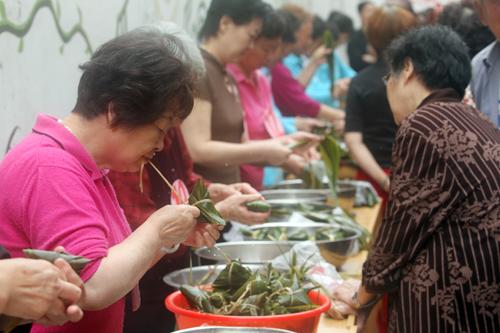
However, late one night, the spirit of Qu Yuan appeared before his friends and told them that the rice meant for him was being intercepted by a huge river dragon. He asked his friends to wrap their rice into three-cornered silk packages to ward off the dragon. This has been a traditional food ever since known as zongzi or sticky rice wrapped in leaves, although they are wrapped in leaves instead of silk. In commemoration of Qu Yuan it is said, people hold dragon boat races annually on the day of his death.

Today, dragon boat festivals continue to be celebrated around the world with dragon boat racing, although such events are still culturally associated with the traditional Chinese Tuen Ng Festival in Hong Kong (Cantonese Chinese dialect) or Duan Wu festival in south central mainland China (Mandarin Chinese dialect).
 
Sources:
www.chinatownconnection.com/chinese-dragon-boat-festival.htm
www.penangforward.net/activity.php?post=15
en.wikipedia.org/wiki/Dragon_boat
Last Updated ( Sunday, 17 May 2009 )
 
new  Qingdao BLOG & BBS
Official Website
Qingdao City Map
Ezine Subscription
News, Reviews
2008 Olympics
Business Directory
Language Corner
Photo Gallery
Travel & Tour Guides
Web Links
About Us
Qingdao Attractions
Beaches, Surf, and Sea
Mountains and Springs
Museums and History
Other Places of Interest
Outlying Tourist Areas
Parks and Gardens
Temples and Churches
Entertainment
Bars, Clubs, KTVs
Cinemas
Restaurants & Cafes
Restaurant Reviews
Recreation & Leisure
Theaters
Qingdao Listings
Art, Books, Antiques
Bakeries, Pizza, Pasta
City Phone Numbers
Banking & Finance
Coffee, Tea, Ice Cream
Colleges, Universities
Computers, Electronics
Department Stores
ESL Schools
Home, Sporting Goods
Hospitals, Dentists
Hostels, Guest Houses
Hotels & Resorts
International Couriers
International Schools
Legal Services
Mandarin Schools
Markets & Shopping
Miscellaneous
Pets, Supplies, Clubs
Plane, Train, Ferry, Bus
Secondary Schools
Services
SuperMarkets
Wine, Cheese, & Spirits
Qingdao Restaurants
Cafes, Diners, & Grills
Chinese BBQ
Chinese Cuisine
Beijing Cuisine
Cantonese Cuisine
Dumpling Restaurants
Chinese Fusion
Hot Pot Restaurants
Seafood Restaurants
Shandong Cuisine
Sichuan Cuisine
Brazilian Cuisine
International Buffet
French Cuisine
International Fusion
German Cuisine
Indian Cuisine
Italian Cuisine
Japanese Cuisine
Korean Cuisine
Mexican Cuisine
Russian Cuisine
Taiwanese Cuisine
Thai Cuisine
Vietnamese Cuisine
© 2009 Qingdao China Guide
| LaoShan Real Estate | Contact Us | Rizhao China Guide | Sitemap | CBD Real Estate |